Learning how to care for a palm plant starts with understanding what your particular palm needs. Palm plants bring a tropical feel to homes, offices, patios, and gardens. Their graceful fronds can make a room feel brighter and more inviting.
However, palms do not all grow under the same conditions. A parlor palm tolerates lower light better than an areca palm, while a majesty palm often needs more consistent moisture and humidity. Treating every palm the same can lead to yellow leaves, crispy tips, weak growth, or root rot.
The good news is that most indoor palms thrive when you get a few essentials right: suitable light, careful watering, airy soil, stable temperatures, and appropriate feeding.
This guide explains how to grow a healthy palm, recognize early warning signs, and solve common care problems before they become serious.
Quick Answer:
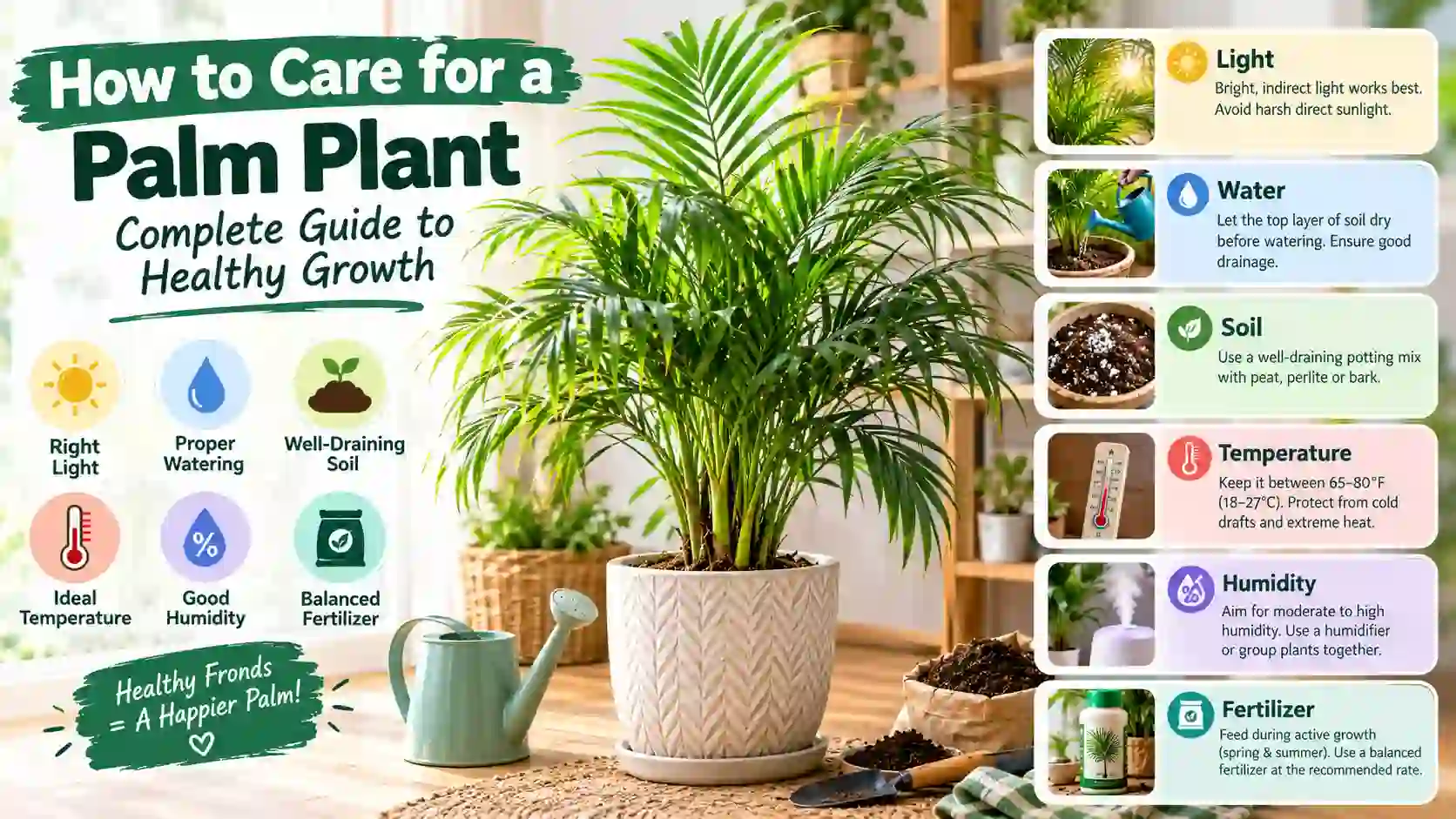
To care for a palm plant, provide bright, indirect light, well-draining soil, and a pot with drainage holes. Water when the top layer of soil begins to dry, adjusting the frequency to your palm species, season, and indoor conditions. Keep humidity comfortable, protect the plant from cold drafts, and feed lightly during active growth. Avoid overwatering, harsh direct sunlight, and excessive fertilizer, which can cause yellowing leaves, brown tips, and root damage.
1. Identify Your Palm Plant Before You Begin
The first step is identifying your palm because its natural growing conditions determine how much light, water, and humidity it needs.
Some palms are naturally adapted to shady forest floors. Others grow in brighter environments and need more space, moisture, or sunlight.

Parlor Palm (Chamaedorea elegans)
A popular beginner-friendly palm that tolerates lower indoor light. It prefers indirect light, moderate watering, and protection from intense afternoon sun.

Areca Palm (Dypsis lutescens)
Its feathery fronds create a lush tropical appearance. It generally prefers bright, indirect light, evenly moist but well-drained soil, and moderate to high humidity.

Lady Palm (Rhapis excelsa)
A slow-growing palm with fan-shaped leaves. It adapts well to indoor conditions and appreciates bright, indirect light and soil that does not remain soggy.

Majesty Palm (Ravenea rivularis)
This palm needs brighter light, consistent moisture, and more attention to humidity than many beginner palms. It can struggle in dry indoor air.
Practical tip: If your palm has thin, feather-shaped fronds, it may be an areca or parlor palm. Fan-shaped leaves suggest a fan palm, such as a lady palm. Check the plant label before changing its care routine.
Image suggestion: A comparison infographic showing parlor, areca, lady, and majesty palms with their names and basic care needs.
2. How Much Light Does a Palm Plant Need?
Most indoor palms grow best in bright, indirect light. This means the room receives plenty of daylight, but the leaves are not exposed to strong direct sunlight for extended periods.
Light affects leaf color, growth rate, and the plant’s ability to use water. A palm in insufficient light may produce fewer leaves and use less water, increasing the risk of overwatering.
Best locations for indoor palms
- Near an east-facing window: Often ideal because the plant receives gentle morning sunlight.
- Near a bright south- or west-facing window: Place the palm a little farther away or filter intense sunlight with a sheer curtain.
- In a room with moderate light: Choose a more shade-tolerant species, such as a parlor palm or lady palm.
- In a dim corner: Consider moving the plant closer to a window or adding a suitable grow light.
Do not assume that a palm survives well simply because it tolerates low light. Survival and healthy growth are different things.
Signs your palm has a lighting problem
| Symptom | Possible cause | What to do |
|---|---|---|
| Pale or bleached patches | Excessive direct sunlight | Move it into filtered light |
| Long, weak growth | Insufficient light | Increase indirect light gradually |
| Slow growth with healthy leaves | Seasonal dormancy or low light | Assess light and seasonal conditions |
| Leaves leaning toward a window | Uneven light | Rotate the pot periodically |
Expert tip: Introduce a palm to brighter conditions gradually. Moving a shade-grown plant directly into intense sunlight can scorch its leaves.
Image suggestion: A palm plant near a bright window, with diagrams showing ideal indirect light, excessive sunlight, and insufficient light.
3. How to Water a Palm Plant Correctly
Watering is one of the most important parts of palm care. Many palms suffer because their roots remain wet for too long, while others develop brown tips when their soil repeatedly becomes too dry.
There is no universal watering schedule for every palm. Pot size, soil composition, temperature, humidity, and plant species all influence how quickly the soil dries.
Follow this simple watering method

Step 1: Check the soil
Insert your finger about 1–2 inches into the soil. For a larger pot, check slightly deeper if the surface feels dry but the center may still be wet.

Step 2: Water thoroughly
If the soil has reached the appropriate dryness for your species, water slowly across the soil surface until excess water drains from the bottom.

Step 3: Allow complete drainage
Empty the saucer or decorative outer pot. Roots should not sit in standing water after watering.

Step 4: Check again before watering
Let the soil dry to the level your palm prefers. Avoid watering again simply because several days have passed.
How often should you water a palm plant?
Indoor palms may need watering every several days or every week or two, depending on their environment. These are only rough possibilities, not a fixed schedule.
| Condition | Watering adjustment |
|---|---|
| Warm, bright conditions | Soil may dry faster |
| Cool winter conditions | Water less often if growth slows |
| Small pot or terracotta pot | Often dries faster |
| Large plastic pot | May retain moisture longer |
| High humidity | Soil may dry more slowly |
| Low humidity and warm air | Soil may dry faster |
Overwatering vs. underwatering
| Sign | Overwatering | Underwatering |
|---|---|---|
| Soil | Stays wet for too long | Becomes very dry |
| Leaves | Yellowing, sometimes wilting | Dry, curled, or crispy |
| Roots | May turn brown and soft | May become dry and damaged |
| Immediate response | Improve drainage and inspect roots if needed | Water thoroughly if the root ball is dry |
These symptoms can overlap. Yellow leaves, for example, may also result from poor light, nutrient problems, pests, or normal aging.
Important: If the soil is wet and the palm is wilting, do not automatically add more water. Check the soil deeper and inspect the drainage first.
Image suggestion: A four-step watering infographic showing soil checking, thorough watering, drainage, and checking moisture again.
4. Choose the Right Soil and Pot
Palm roots need both moisture and oxygen. Soil that holds water for too long can deprive roots of oxygen and encourage root rot.
A suitable potting mix retains enough moisture for the plant while allowing excess water to drain.
What soil is best for palm plants?
For many indoor palms, start with a quality indoor potting mix and improve its structure with materials such as perlite or fine orchid bark if it retains too much water.
A practical starting mix is:
- Two parts quality indoor potting mix.
- One part perlite or pumice.
- One part fine orchid bark, if additional structure is needed.
This is a flexible starting point rather than a universal formula. Adjust the mix to your palm’s moisture needs and your home’s conditions.
How to choose the right pot
Choose a pot with drainage holes. When repotting, select a container only modestly larger than the current root ball.
An oversized pot can hold excess moisture around a small root system. A pot that is too small can restrict roots and dry out rapidly.
Terracotta pots allow moisture to evaporate through their sides, while plastic pots retain moisture longer. Neither is automatically better; choose according to your watering habits and growing conditions.
Common mistake: Adding a thick layer of gravel at the bottom of a pot does not improve drainage through the soil. Use drainage holes and an appropriate potting mix instead.
Image suggestion: A cutaway illustration of a palm pot showing healthy roots, airy soil, drainage holes, and water flowing out.
5. Maintain Suitable Temperature and Humidity
Most popular tropical indoor palms prefer stable temperatures and protection from cold drafts. Many grow comfortably at typical indoor temperatures of roughly 65–80°F (18–27°C), although individual species differ.
Keep your palm away from:
- Cold windows during chilly weather.
- Air-conditioning vents that blow directly onto the leaves.
- Hot radiators and heating vents.
- Sudden temperature changes.
Does a palm plant need high humidity?
Some palms, particularly areca and majesty palms, appreciate moderate to high humidity. Dry air can contribute to crispy leaf tips, especially when combined with irregular watering or mineral buildup.
You can improve humidity by using a room humidifier or grouping plants together, provided air can circulate freely.
Misting leaves offers only a brief increase in surface moisture and is not a dependable way to maintain humidity. Constantly wet foliage in poorly ventilated conditions may also encourage leaf problems.
A useful distinction: Brown leaf tips do not always mean the air is too dry. Check watering, root health, water quality, and fertilizer use before making major changes.
Image suggestion: A healthy indoor palm beside a humidifier, with temperature and humidity icons.
6. How to Fertilize a Palm Plant
Palms need nutrients for healthy roots, green fronds, and new growth. However, excess fertilizer can damage roots and cause brown leaf tips or leaf-edge burn.
Use a fertilizer labeled for palms or a balanced houseplant fertilizer appropriate for your species. Follow the product label rather than increasing the dose to encourage faster growth.
Best fertilizing practices
- Fertilize mainly during active growth, usually spring and summer for indoor palms in temperate climates.
- Apply fertilizer to appropriately moist soil, following label instructions.
- Reduce or stop feeding when growth slows during winter.
- Avoid fertilizing a severely stressed plant until you identify and address the underlying problem.
- If salt buildup is suspected, flush the potting mix with suitable water when drainage is effective.
Some palms have specific micronutrient requirements. Outdoor palms, especially those growing in nutrient-poor soils, may need a specialized palm fertilizer.
For indoor palms, regular light feeding is generally safer than frequent heavy applications.
Expert tip: Fertilizer is not a cure for every yellow leaf. If roots are damaged or the plant lacks light, additional nutrients will not fix the main problem.
Image suggestion: An infographic showing measured fertilizer application, healthy green fronds, and a warning against overfertilizing.
7. Pruning and Cleaning Palm Leaves
Palm plants do not need frequent pruning. Their fronds collect sunlight, so removing healthy leaves can reduce the plant’s ability to grow.
Prune only when necessary, and use clean, sharp scissors or pruning shears.
How to prune a palm safely
- Remove fully brown fronds: Cut dead leaves near the base of the leaf stalk without damaging the trunk or main stem.
- Leave partly green fronds: Green tissue still contributes to photosynthesis, even if the leaf tips are brown.
- Do not cut the growing point: Many palms have a central growing point called the crown. Damaging it can seriously harm the plant.
- Avoid excessive pruning: Never remove numerous green fronds just to make the plant look smaller.
Brown tips can be trimmed for appearance, but follow the natural shape of the leaf. Removing only the dead portion helps preserve the healthy tissue.
How to clean palm leaves
Dust can accumulate on broad or feathery fronds, reducing their appearance and making pest inspection harder.
Wipe suitable leaves gently with a soft, damp cloth. For finely divided fronds, a gentle shower with lukewarm water may help, provided the plant can drain properly and dry in good airflow.
Avoid leaf-shine products unless the plant’s care guidance specifically supports their use.
Image suggestion: A close-up showing the correct removal of a fully brown palm frond and the gentle cleaning of healthy green leaves.
8. Repotting a Palm Plant Without Stressing It
Palms often grow more slowly than many other houseplants. They do not necessarily need repotting every year.
Repot when roots crowd the container, the soil structure deteriorates, or water moves through the pot unusually quickly because the root ball has become densely packed.
Signs your palm needs repotting
- Roots emerge from the drainage holes.
- The root ball becomes tightly packed.
- Water runs around the edges without adequately moistening the soil.
- Growth declines despite suitable light, watering, and nutrition.
- The pot becomes unstable because the plant has outgrown it.
Roots appearing through a drainage hole alone do not always mean immediate repotting is necessary. Consider the plant’s overall condition.
Step-by-step repotting guide
- Choose a pot with drainage holes that is only slightly larger than the existing root ball.
- Prepare a fresh, well-draining potting mix suitable for the species.
- Slide the plant out gently, supporting the root ball.
- Inspect roots and remove only those that are clearly dead, mushy, or badly damaged.
- Place the palm at the same depth it previously grew.
- Fill around the roots without compacting the soil excessively.
- Water according to the plant’s needs and let excess water drain.
- Return the palm to a suitable location and avoid fertilizing immediately if the roots were disturbed significantly.
Palms can react poorly to unnecessary root disturbance. Handle their roots carefully, and do not divide a palm unless its growth habit and species make division appropriate.
Image suggestion: A four-panel repotting infographic showing root inspection, pot selection, fresh soil, and a settled palm.
9. Common Palm Plant Problems and How to Fix Them
A palm’s leaves often reveal changes in its growing conditions. The important step is identifying the pattern rather than treating every symptom with extra water or fertilizer.

Problem 1: Yellow Leaves
Possible causes: Overwatering, poor drainage, insufficient light, nutrient deficiencies, or natural aging of older fronds.
Fix: Check soil moisture and root health first. Review light and feeding, and determine whether the yellowing affects old leaves or new growth.

Problem 2: Brown Leaf Tips
Possible causes: Low humidity, inconsistent watering, mineral accumulation, fertilizer salts, or root damage.
Fix: Check watering consistency and drainage. If tap water contains high levels of dissolved minerals, consider rainwater or another suitable low-mineral source when practical.

Problem 3: Drooping or Wilting Fronds
Possible causes: Dry roots, waterlogged soil, root rot, heat stress, or sudden environmental changes.
Fix: Check moisture several inches below the surface. Water if the root ball is dry; if it is persistently wet, investigate drainage and root health.

Problem 4: Spider Mites or Other Pests
Possible causes: Spider mites, scale insects, mealybugs, or other sap-feeding pests.
Fix: Inspect leaf undersides and stems. Isolate affected plants, remove pests where practical, and use a labeled insecticidal soap or other appropriate treatment according to its instructions.

Problem 5: Slow or Weak Growth
Possible causes: Low light, cool temperatures, seasonal slowdown, restricted roots, or insufficient nutrients.
Fix: Review growing conditions before adding fertilizer. Some palms naturally grow slowly, so new leaves may appear only occasionally.
How to recognize root rot
Root rot is especially concerning when the soil stays wet and the plant begins to decline.
Check for these warning signs:
- Persistent wet soil despite reduced watering.
- A sour or unpleasant smell from the root ball.
- Soft, dark roots that break apart easily.
- Yellowing or wilting that continues even though the soil is wet.
Healthy roots are generally firm, although their natural color varies by species and growing medium.
If root rot is suspected, remove the plant carefully, trim clearly rotten roots with clean tools, and repot it in fresh, well-draining soil. Severe damage to the growing point or root system may be difficult to reverse.
Image suggestion: A diagnostic infographic comparing a healthy palm with yellowing leaves, crispy tips, drooping fronds, and root rot.
10. Seasonal Palm Plant Care
A palm’s water and nutrient needs change as light, temperature, and growth rates change throughout the year.
Spring
Spring often brings renewed growth for indoor palms.
- Check whether the plant needs repotting.
- Resume moderate feeding if active growth begins.
- Gradually increase light if winter conditions were dim.
- Inspect new leaves for pests.
Summer
Warmer temperatures and stronger light may increase water use.
- Check soil more frequently.
- Protect indoor palms from intense afternoon sunlight.
- Maintain airflow without exposing plants to harsh, drying drafts.
- Monitor outdoor containers for rapid drying.
Autumn
As daylight decreases, growth may slow.
- Reduce fertilizer as growth declines.
- Adjust watering based on actual soil moisture.
- Inspect plants before bringing outdoor palms indoors.
- Remove pests before moving plants near other houseplants.
Winter
Many indoor palms use less water during cooler, darker months.
- Water less frequently when the soil dries more slowly.
- Keep plants away from cold drafts and heating vents.
- Provide sufficient light, using a grow light if necessary.
- Avoid fertilizing heavily when growth has slowed.
For outdoor palms: Seasonal care depends on species and local climate. Some palms tolerate frost, while tropical species can suffer serious cold damage. Check your palm’s cold tolerance before leaving it outdoors through winter.
Image suggestion: A four-season palm care calendar with watering, light, temperature, and feeding reminders.
11. Growing Palm Plants Indoors vs. Outdoors
Some palms thrive as houseplants, while others need the stronger light, space, and climate found outdoors.
| Care factor | Indoor palms | Outdoor palms |
|---|---|---|
| Light | Usually bright, indirect light | Depends on species; may range from shade to full sun |
| Water | Based on potting mix dryness | Based on rainfall, soil drainage, and weather |
| Soil | Airy container mix | Well-draining ground soil or suitable containers |
| Humidity | Often affected by indoor heating and air-conditioning | Depends on the local climate |
| Fertilizer | Usually light feeding during active growth | May need species-appropriate feeding based on soil conditions |
| Cold protection | Protect from cold windows and drafts | Match species to local winter temperatures |
A palm that grows outdoors in a tropical garden may struggle inside a dim room. Conversely, a shade-tolerant indoor palm can scorch if placed directly in intense outdoor sunlight.
When moving a palm outdoors, acclimate it gradually. Begin in a sheltered, shaded location and increase light exposure according to the species.
12. Expert Tips for Healthier Palm Plants
Small adjustments often make a bigger difference than buying more products.
1. Track soil moisture, not calendar dates. A weekly watering reminder is useful only if you check whether the plant actually needs water.
2. Match the pot to the root system. A large decorative pot may look attractive, but excessive soil around a small root ball can stay wet too long.
3. Investigate symptoms before treating them. Yellow leaves do not automatically indicate a fertilizer deficiency, and brown tips do not always mean low humidity.
4. Change one major factor at a time. If you move the palm, increase watering, add fertilizer, and raise humidity simultaneously, it becomes difficult to identify what helped.
5. Expect gradual recovery. Existing brown tissue will not turn green again. Look for healthier new growth and a slower spread of damage.
6. Check the quality of your water. Some palms are sensitive to mineral accumulation. Where water is very hard, suitable rainwater or filtered water may help, depending on its mineral content.
7. Inspect plants regularly. Check the undersides of leaves, the base of the stems, and the soil surface. Early pest detection is much easier than managing a large infestation.
8. Choose the right palm for your space. If your room has limited light and you are a beginner, a parlor palm may be a more practical choice than a demanding majesty palm.
9. Keep the foliage clean. Dust removal makes leaves look better and helps you spot pests and developing damage.
10. Be patient with growth. Palms generally do not respond well to constant repotting, aggressive pruning, or heavy fertilizing. Stable conditions often produce better results.
13. Frequently Asked Questions About Palm Plant Care
How often should I water my palm plant?
Water when the upper layer of soil has dried to the level preferred by your palm species. Many indoor palms need water every several days to two weeks, depending on conditions. Always check soil moisture before watering.
Do palm plants need direct sunlight?
Most popular indoor palms prefer bright, indirect light. Some outdoor species tolerate full sun, while shade-adapted palms can develop scorched leaves under intense sunlight. Identify your species before changing its light exposure.
Why are the leaves on my palm plant turning yellow?
Yellow leaves can indicate overwatering, poor drainage, low light, nutrient deficiencies, or natural aging. Check the soil and roots first. If only an occasional older frond yellows while new growth remains healthy, it may be part of the normal aging process.
Why does my palm plant have brown tips?
Brown tips may result from inconsistent watering, low humidity, fertilizer salts, mineral-rich water, or damaged roots. Check these factors before purchasing a humidifier or changing your watering schedule.
Are palm plants easy to care for indoors?
Some palms are relatively easy to maintain indoors. Parlor palms and lady palms are generally good options for beginners because they tolerate typical indoor conditions better than some demanding species. Adequate light and proper watering remain essential.
Should I cut off brown palm leaves?
Remove fully brown, dead fronds with clean pruning tools. If a leaf has only brown tips, you can trim the damaged portions while preserving as much green tissue as possible. Avoid cutting the growing point or removing too many healthy fronds.
Do palm plants need fertilizer?
Yes, most potted palms benefit from occasional feeding during active growth. Use an appropriate fertilizer at the recommended rate. Excess fertilizer can damage roots and contribute to brown leaf tips.
Can I grow a palm plant in low light?
Some palms tolerate low light, particularly parlor palms and lady palms. However, very dim conditions can cause weak growth and slow water use. A brighter location or suitable grow light may improve plant health.
When should I repot my palm plant?
Repot when roots become crowded, the growing medium breaks down, or the plant repeatedly struggles with water absorption. Choose a pot only slightly larger than the root ball and avoid unnecessary root disturbance.
How do I make my palm plant grow faster?
Provide suitable light, appropriate watering, well-draining soil, stable temperatures, and balanced nutrition. Growth also depends on the species. Avoid forcing faster growth with excessive fertilizer or frequent watering.
Are palm plants safe for pets?
Pet safety depends on the species. True palms such as parlor palms and areca palms are generally considered non-toxic to cats and dogs. However, sago palms are not true palms and are highly toxic to pets. Verify the plant’s identity before placing it within reach of animals.
Conclusion
Learning how to care for a palm plant is mainly about creating stable growing conditions and responding to what the plant needs.
Start with the right location, a well-draining pot, and a watering routine based on soil moisture. Maintain suitable humidity, fertilize moderately during active growth, and remove only damaged or dead foliage. When problems appear, examine the roots, light, and watering habits before trying a quick fix.
Most importantly, remember that different palm species have different requirements. Identify your plant, make gradual adjustments, and watch its new growth for signs of improvement.
With consistent care and a little patience, your palm can develop healthy fronds and become a beautiful, long-lasting part of your home or garden.