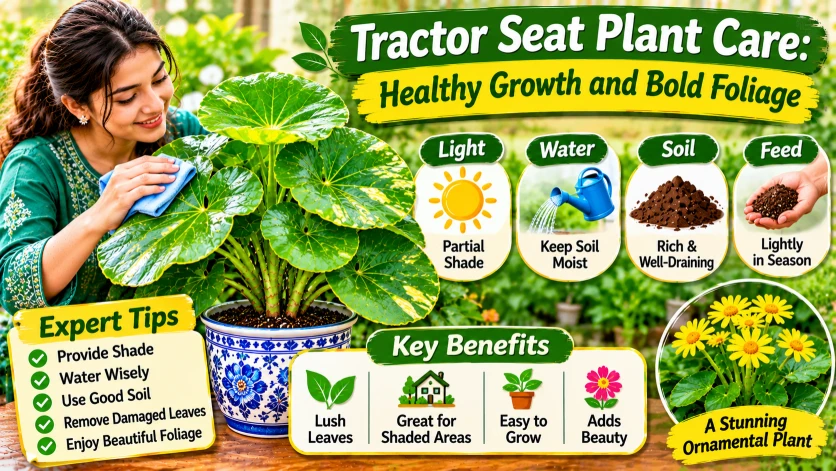
The tractor seat plant is loved for its dramatic foliage, rounded leaves, and tropical-looking appearance. Its large, often glossy leaves create a striking feature in shaded gardens, woodland borders, and moisture-friendly landscapes.
However, those oversized leaves can lose their appeal when the plant receives too much sun, dries out, or grows in unsuitable soil. Leaves may wilt, develop brown edges, or become damaged by wind and pests.
Understanding tractor seat plant care helps you maintain healthy foliage and encourage steady growth. This guide explains its light, water, soil, feeding, pruning, propagation, and common problems, with practical advice for growing it in garden beds or containers.
Quick Answer:
Tractor seat plants grow best in partial to full shade, consistently moist but well-drained soil, and a cool, sheltered position. Water regularly, especially during hot weather, and protect their large leaves from harsh afternoon sun. Feed lightly during active growth and remove damaged foliage. Correct identification matters because “tractor seat plant” can refer to different bold-leaved ornamental plants.
Identify the Tractor Seat Plant Correctly
The plant most commonly sold as the tractor seat plant is Farfugium japonicum, also known as leopard plant or giant leopard plant.
It belongs to the daisy family, Asteraceae, and originates from Japan and nearby parts of East Asia. In its natural habitat, it grows in moist areas, including streambanks and woodland edges. N.C. Cooperative Extension+2
Its main features include:
- Large, rounded or kidney-shaped leaves.
- Thick, glossy green foliage.
- Yellow or cream spots on certain varieties.
- A clumping growth habit.
- Small, daisy-like yellow flowers, usually appearing in autumn or winter depending on climate.
Popular tractor seat plant varieties
| Variety | Leaf appearance | Best feature |
|---|---|---|
| ‘Giganteum’ | Very large, glossy green leaves | Oversized foliage |
| ‘Aureomaculatum’ | Green leaves with yellow spots | Leopard-like pattern |
| ‘Argenteum’ | Green leaves with pale markings | Decorative contrast |
| ‘Crispatum’ | Curled or wavy leaves | Unusual texture |
| ‘Kin Kan’ | Green leaves with yellow edges | Bright leaf margins |
The varieties differ in leaf size, color, and texture. Choose one based on the space and visual effect you want. Gardening Solutions+1
Important identification note: Some gardeners also use “leopard plant” for Ligularia dentata and related plants. These are close ornamental relatives, but they are not the same species. This guide focuses on Farfugium japonicum, the plant most commonly called tractor seat plant. Plant Finder+2
Choose the Best Location and Light Conditions
Light is one of the biggest factors affecting tractor seat plant health. Its large leaves can lose moisture quickly in strong sunlight, especially during hot afternoons.
The best location is usually partial shade or filtered shade.
How much sunlight does a tractor seat plant need?
- Partial shade: Ideal for many gardens.
- Dappled shade: Excellent for maintaining attractive foliage.
- Full shade: Often suitable, although growth and flowering may be reduced.
- Strong afternoon sun: Can cause wilting, leaf scorch, and dry edges.
Morning sunlight may be tolerated in cooler climates if the soil remains moist. In warmer climates, prioritize afternoon shade.
Where should you place it?
Good locations include:
- Under a tree with filtered light.
- Beside a shaded garden wall.
- Near a pond or water feature.
- In a sheltered courtyard.
- On a shaded patio in a large container.
If you live in a hot region, such as parts of Pakistan, avoid placing the plant where it receives intense afternoon sunlight. A shaded patio or protected garden corner is generally a better choice.
Expert tip: Do not assume a plant needs more water every time its leaves wilt in the afternoon. Excessive sunlight and heat can cause temporary wilting even when the soil is moist. Check the soil before watering.
Watering a Tractor Seat Plant the Right Way
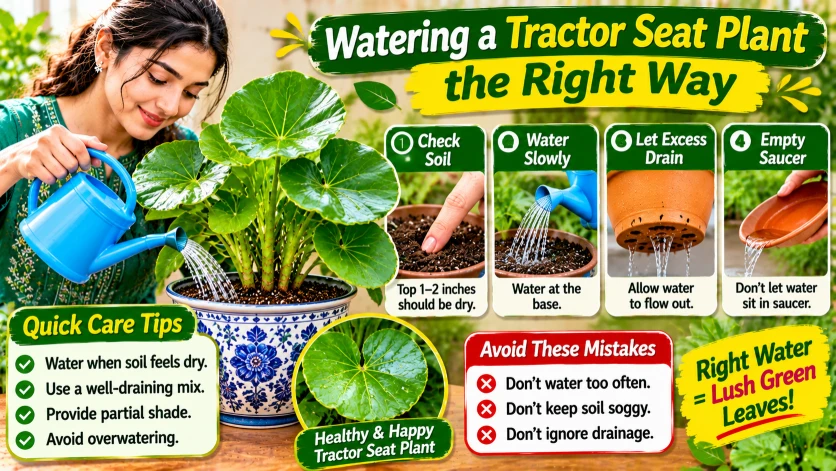
Tractor seat plants prefer consistently moist soil. Their large leaves use water, and the plant can wilt when the root zone becomes too dry.
However, keeping the roots permanently saturated can cause root problems. The goal is steady moisture with enough drainage for healthy roots.
When should you water?
Check the soil rather than following a fixed daily schedule.
- If the upper layer is slightly dry, check deeper before watering.
- If the root zone still feels moist, wait.
- If the soil is becoming dry, water thoroughly.
- During hot, dry weather, check more frequently.
Newly planted specimens need closer attention while their roots establish.
Step-by-step watering method
- Check the soil around the base of the plant.
- Apply water slowly to the root zone.
- Water deeply enough to moisten the surrounding soil.
- Allow excess water to drain away.
- Check again during hot weather or dry spells.
Avoid repeatedly giving the plant tiny amounts of water. Deep watering encourages moisture to reach the root zone.
Signs of watering problems
| Symptom | Possible cause | What to do |
|---|---|---|
| Limp leaves and dry soil | Underwatering | Water deeply |
| Wilting in hot sunshine | Heat or sun stress | Provide shade and check soil |
| Yellow leaves with soggy soil | Possible overwatering | Improve drainage |
| Soft, damaged roots | Prolonged waterlogging | Remove rotten roots and correct soil conditions |
| Crispy leaf edges | Dryness, heat, or wind | Check moisture and shelter the plant |
Farfugium can wilt during hot weather even when its soil is adequately moist. If the leaves recover in the evening, heat stress may be contributing. N.C. Cooperative Extension+2
Image suggestion: A watering guide showing a healthy tractor seat plant, moist soil, a watering can, and a drainage comparison.
Prepare Rich, Moist, Well-Draining Soil
Soil quality has a direct effect on leaf size and plant vigor. Tractor seat plants grow best in fertile soil that retains moisture without becoming stagnant.
A loose, organic-rich growing medium supports healthy roots and reduces the risk of waterlogging.
What type of soil is best?
Look for soil that is:
- Rich in organic matter.
- Moisture-retentive.
- Loose enough for root growth.
- Well-draining.
- Suitable for perennial ornamental plants.
Simple soil preparation
For a garden bed, improve ordinary soil by mixing in:
- Mature compost.
- Leaf mold or well-rotted organic matter.
- A small amount of coarse material if drainage needs improvement.
For container growing, use a quality potting mix amended with perlite or pumice to improve aeration.
Do not use heavy, compacted soil that remains saturated for long periods.
Should tractor seat plants grow in wet soil?
They appreciate moist conditions and can tolerate damp ground, but constantly stagnant water is not a good substitute for healthy soil structure. Moisture and drainage need to work together.
Practical observation: If water remains pooled around the plant long after irrigation, improve the planting area’s drainage rather than simply reducing water to the point that the plant dries out.
Maintain Suitable Temperature and Humidity
Tractor seat plants prefer conditions that resemble their natural moist, sheltered habitat. They generally perform best when protected from extreme heat, drying winds, and severe cold.
Temperature considerations
Farfugium japonicum is generally grown as a perennial in mild climates. Its hardiness is commonly listed around USDA Zones 7–10, although cultivar and local conditions matter. Plant Finder+2
For successful growth:
- Protect leaves from intense heat.
- Avoid exposed positions with strong drying winds.
- Provide shelter during cold spells.
- Use a suitable protected location for container plants in colder regions.
Does it need high humidity?
Moderate to naturally humid conditions are helpful, especially in warm weather. However, the plant does not need constant misting.
To reduce leaf stress:
- Keep the soil evenly moist.
- Grow it in a sheltered position.
- Avoid hot, drying airflow.
- Maintain enough spacing for air circulation.
In hot climates, shade and consistent soil moisture are usually more useful than frequent leaf misting.
Fertilize for Strong Leaves and Healthy Growth
Tractor seat plants benefit from fertile soil, but they do not need excessive fertilizer.
A layer of mature compost can improve soil structure and provide a gentle supply of nutrients. You can also use a balanced, slow-release fertilizer according to its label.
When should you fertilize?
- Spring: Apply compost or a light application of balanced fertilizer as growth resumes.
- Summer: Feed only if the plant is actively growing and needs it.
- Autumn: Avoid unnecessary heavy feeding.
- Winter: Usually no routine feeding is needed where growth slows.
Signs of excessive fertilizer
- Brown leaf margins.
- Weak or soft growth.
- Salt deposits on the soil surface.
- Poor plant condition despite regular feeding.
Do not fertilize a drought-stressed or severely heat-stressed plant. Correct its growing conditions first.
Expert tip: A healthy soil structure and consistent moisture are more important than frequent fertilizer applications.
How to Grow Tractor Seat Plants in Pots
Tractor seat plants grow well in containers, making them useful for shaded patios, balconies, and courtyards.
Container growing also allows you to move the plant when sunlight or weather conditions become unsuitable.
Choosing the right pot
Select a container that:
- Has several drainage holes.
- Is wide enough for the plant’s spreading clump.
- Is stable enough to support its large leaves.
- Provides room for root development.
- Is not excessively oversized.
A heavy ceramic or terracotta pot can help prevent a mature plant from tipping over in the wind.
Container care tips
- Use a moisture-retentive but well-draining potting mix.
- Place the container in partial or filtered shade.
- Check moisture more frequently during hot weather.
- Water thoroughly when the growing medium begins to dry.
- Remove water collected in the outer pot or saucer.
- Repot when the plant becomes crowded.
Container soil usually dries faster than garden soil. During hot weather, check it regularly rather than assuming that yesterday’s watering is still sufficient.
Prune and Maintain the Large Leaves
Tractor seat plants do not require heavy pruning. Their attractive foliage is the main reason gardeners grow them.
Most maintenance involves removing old, damaged, or unattractive leaves.
How to prune correctly
- Inspect the plant for yellow, brown, or damaged leaves.
- Use clean, sharp garden scissors or pruning shears.
- Cut unwanted leaves near their base without damaging healthy growth.
- Remove dead flower stems after flowering if desired.
- Clear away fallen leaves around the crown.
Avoid cutting healthy foliage simply to make the plant smaller. If the clump has become too large, dividing it is usually a better option.
Should you remove the yellow flowers?
Farfugium produces clusters of small, yellow, daisy-like flowers. Some gardeners enjoy these seasonal blooms, while others prefer the appearance of foliage alone.
You can leave the flowers to enjoy their color and provide a nectar source for visiting pollinators. Alternatively, remove flower stalks if you want to keep the focus on the leaves. Gardening Solutions+1
How to Propagate Tractor Seat Plants
The easiest way to propagate a tractor seat plant is by dividing an established clump. This method produces new plants while helping control the size of an older specimen.
Best time to propagate
Spring is generally a good time for division because the plant can establish new roots as active growth resumes. Gardening Solutions+2
Step-by-step division method
- Water the parent plant if the soil is dry.
- Carefully loosen the soil around the clump.
- Lift the plant without pulling roughly on its leaves.
- Identify natural sections with healthy roots and growing points.
- Separate the sections using clean tools.
- Replant each division at its original depth.
- Water thoroughly and keep the soil evenly moist while the divisions establish.
Each division should have enough healthy roots and at least one active growing point.
Can you grow tractor seat plants from seeds?
Yes. Seeds can be sown in suitable containers under protected conditions. However, division is usually more straightforward for home gardeners.
Seed-grown plants may also differ from named cultivars, particularly when the parent has distinctive spotted or variegated leaves. leopard plant+1
Image suggestion: A four-step propagation infographic showing an established clump, separated divisions, healthy roots, and newly planted tractor seat plants.
Repotting and Dividing an Overgrown Plant
An established tractor seat plant gradually expands into a larger clump. If it becomes crowded in a container, its growth may slow and the soil may become difficult to manage.
Signs your plant needs repotting
- Roots fill most of the container.
- The plant dries out unusually quickly.
- The clump becomes unstable.
- Roots emerge from the drainage holes.
- Growth becomes crowded in the center.
How to repot it
- Choose a slightly wider container with drainage holes.
- Prepare fresh, organic-rich potting mix.
- Remove the plant carefully.
- Inspect the roots and remove damaged or rotten sections.
- Position the plant at its previous growing depth.
- Fill around the roots with fresh mix.
- Water thoroughly and allow excess water to drain.
If the clump is too large for one container, divide it into smaller sections rather than repeatedly moving it into oversized pots.
Common Tractor Seat Plant Problems and Solutions
Most tractor seat plant problems are related to sunlight, water, soil conditions, or pests. Because its leaves are large and noticeable, changes in their appearance can provide useful clues.
Why are tractor seat plant leaves turning brown?
Brown edges or patches can develop when leaves experience:
- Strong direct sunlight.
- Dry soil.
- Hot, drying winds.
- Root damage.
- Physical damage.
How to fix it:
Move the plant into filtered shade, check soil moisture, and protect it from drying winds. Remove leaves that are badly damaged.
Why is my tractor seat plant wilting?
Wilting is one of the most common symptoms gardeners notice.
Possible causes include:
- Dry soil.
- Excessive heat.
- Strong sunlight.
- Root damage.
- Poor drainage.
Check the soil before watering. If it is dry, water deeply. If it is already wet, avoid adding more water and investigate the roots and drainage.
Why are tractor seat plant leaves turning yellow?
Yellow leaves may indicate natural aging, water stress, or root problems.
If older outer leaves turn yellow while new leaves remain healthy, natural aging may be responsible.
If several leaves turn yellow together and the soil stays wet, check for poor drainage or damaged roots.
Why does my tractor seat plant have holes in its leaves?
Holes and irregular edges often point to chewing pests.
Slugs and snails are particularly troublesome for Farfugium, especially in moist, shaded gardens. Inspect the plant after dark or early in the morning when these pests are more active. Home & Garden Information Center+2
Why is my tractor seat plant not growing?
Slow growth can be associated with:
- Insufficient light.
- Dry or compacted soil.
- Root crowding.
- Seasonal growth patterns.
- Excessive heat or cold.
Improve its growing conditions before adding more fertilizer. A plant under environmental stress rarely benefits from extra feeding.
Troubleshooting table
| Problem | Likely cause | Recommended solution |
|---|---|---|
| Brown leaf edges | Sun, wind, or dry soil | Provide shade and consistent moisture |
| Yellow leaves | Aging or root stress | Check leaf age and soil drainage |
| Drooping leaves | Heat or water stress | Check soil before watering |
| Holes in leaves | Slugs or snails | Inspect and control pests |
| Soft roots | Waterlogged soil | Improve drainage and remove rot |
| Slow growth | Poor conditions or crowding | Review light, soil, and root space |
| Scorched patches | Strong direct sunlight | Move to a sheltered position |
Protect Tractor Seat Plants From Pests and Diseases
Tractor seat plants are generally considered relatively low-maintenance, but their broad leaves can attract certain garden pests.
Slugs and snails
Slugs and snails are among the main pests to watch for.
They may leave:
- Irregular holes in leaves.
- Ragged leaf edges.
- Silvery slime trails.
- Damage around young foliage.
Control methods:
- Inspect plants after rainfall and during cooler evenings.
- Remove hiding places such as piles of damp debris.
- Hand-pick visible pests.
- Use suitable slug-control products according to their labels.
- Protect young plants while they establish.
Aphids and other sap-feeding insects
Occasionally inspect new growth and leaf undersides for small insects. If pests appear, rinse the affected foliage gently or remove small infestations manually.
For persistent infestations, use a product labeled for the identified pest and ornamental plant.
Preventing disease
Good growing conditions help reduce plant stress.
- Avoid planting in stagnant, waterlogged soil.
- Remove decaying leaves.
- Keep tools clean.
- Allow adequate airflow around the plant.
- Avoid unnecessary overhead watering late in the day.
Farfugium is generally not considered highly disease-prone, but poor drainage and damaged roots can still cause problems. leopard plant+2
Seasonal Tractor Seat Plant Care
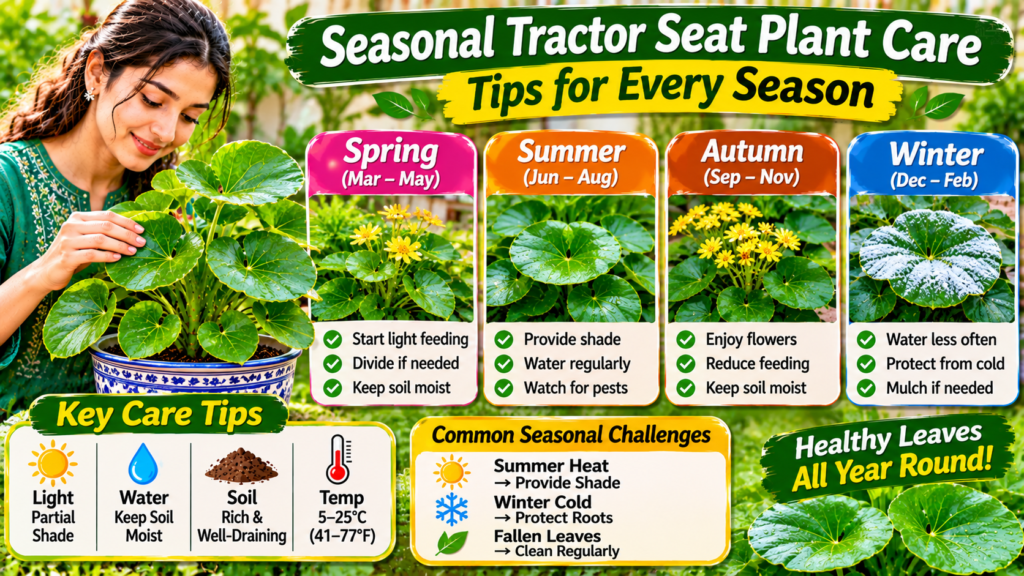
The plant’s care requirements change with temperature, rainfall, and growth activity. Adjust your routine according to local weather rather than following a rigid calendar.
Spring care
Spring is a useful time to encourage fresh foliage and expand your planting.
- Remove damaged leaves.
- Divide crowded clumps.
- Add mature compost around the plant.
- Apply light fertilizer if needed.
- Check new growth for pests.
Summer care
Summer heat can be challenging because large leaves lose moisture quickly.
- Provide afternoon shade.
- Check soil moisture regularly.
- Water deeply when needed.
- Protect the plant from strong drying winds.
- Inspect leaves for scorch and pest damage.
In hot climates, a shaded position is more important than increasing watering alone.
Autumn care
In mild climates, Farfugium may produce its yellow flowers during autumn.
- Remove damaged foliage.
- Keep the soil reasonably moist.
- Enjoy the flowers or remove spent stalks.
- Collect mature seeds if you want to experiment with propagation.
Winter care
In mild climates, the plant may retain much of its foliage. In colder regions, growth can slow and foliage may become damaged.
- Reduce watering if the soil dries slowly.
- Remove dead foliage.
- Protect plants from severe cold.
- Apply suitable mulch where winter protection is needed.
- Keep container plants in a sheltered position.
The Royal Horticultural Society recommends protection from cold, drying winds and winter mulch in colder conditions. leopard plant+1
Growing Tractor Seat Plants in Hot Climates
Hot weather deserves special attention because the plant’s large leaves can wilt or scorch when exposed to strong sunlight.
If you live in a region with very hot summers, consider the following:
Choose deep shade during the hottest part of the day. Filtered morning light is generally safer than intense afternoon exposure.
Maintain moisture around the roots. A layer of organic mulch can help slow soil drying. Keep mulch slightly away from the plant’s crown to reduce the risk of rot.
Use a sheltered location. Walls, fences, and larger plants can reduce exposure to hot, drying winds.
Check containers more frequently. Pots can heat up and dry faster than garden beds.
Do not confuse heat wilting with drought. Check the soil before watering. If it is already moist, additional water may create root problems without solving the heat stress.
The North Carolina Cooperative Extension specifically notes that Farfugium can wilt in hot summer climates even when it receives adequate moisture, particularly in excessive sun. N.C. Cooperative Extension+1
Common Tractor Seat Plant Care Mistakes to Avoid
Even experienced gardeners can overlook small details that affect this plant’s appearance.
| Mistake | Why it causes problems | Better practice |
|---|---|---|
| Planting in harsh afternoon sun | Leaves can wilt and burn | Choose filtered or partial shade |
| Allowing soil to dry completely | Large leaves may lose firmness | Maintain consistent moisture |
| Using compacted soil | Roots may struggle with poor aeration | Add organic matter and improve structure |
| Watering without checking the soil | Can lead to waterlogging | Check moisture first |
| Ignoring slug damage | Holes can spread across foliage | Inspect regularly |
| Using too much fertilizer | Can stress roots and damage foliage | Feed lightly |
| Exposing leaves to strong wind | Large leaves can tear and dry | Choose a sheltered position |
| Planting in a pot without drainage | Water collects around roots | Use a container with drainage holes |
The most important lesson is to balance moisture with drainage. Tractor seat plants enjoy damp soil, but their roots still need oxygen.
Frequently Asked Questions About Tractor Seat Plant Care
How much sunlight does a tractor seat plant need?
It grows best in partial shade or filtered light. Protect it from strong afternoon sunlight because its large leaves can wilt and scorch.
How often should I water a tractor seat plant?
Water when the soil begins to dry. Check moisture regularly, especially during hot weather. Keep the soil consistently moist without allowing water to remain stagnant around the roots.
Can a tractor seat plant grow indoors?
Yes. It can grow indoors in a bright location with indirect light. Choose a large container with drainage holes and maintain consistent soil moisture. Avoid placing it beside hot windows or strong air-conditioning vents.
Why are my tractor seat plant leaves drooping?
Drooping may result from dry soil, heat, strong sunlight, or root problems. Check the soil first. If it is moist, provide shade and investigate drainage rather than adding more water.
Does the tractor seat plant flower?
Yes. Mature plants can produce clusters of small, bright yellow, daisy-like flowers. Flowering usually occurs in autumn or winter, depending on the climate and growing conditions.
Can tractor seat plants grow in full shade?
Yes. They tolerate full shade and often perform well in sheltered garden locations. However, very deep shade may reduce growth and flowering.
How do you propagate a tractor seat plant?
The easiest method is division. Separate an established clump into smaller sections, making sure each division has healthy roots and growing points. Replant in moist, well-draining soil.
Is a tractor seat plant suitable for containers?
Yes. It grows well in large containers on shaded patios and balconies. Use a moisture-retentive potting mix, provide drainage holes, and check soil moisture regularly.
Why does my tractor seat plant have holes in its leaves?
Slugs and snails are common causes of holes and ragged edges. Inspect the leaves and surrounding soil, especially after rain or during the evening.
Is the tractor seat plant evergreen?
Farfugium japonicum is generally classified as an evergreen perennial in suitable mild climates. Cold conditions can damage its foliage, so its appearance may vary by region.
How big does a tractor seat plant grow?
Many varieties reach approximately 1–2 feet in height and spread, although larger forms such as ‘Giganteum’ can develop substantially bigger leaves. Final size depends on the variety and growing conditions. Plant Finder+2
Conclusion
Successful tractor seat plant care starts with choosing the right location. Give Farfugium japonicum partial shade, rich soil, consistent moisture, and protection from harsh sunlight and drying winds.
Pay particular attention to its large leaves. Wilting, brown edges, and holes can reveal problems with heat, watering, or pests. Check the soil before watering, improve drainage when necessary, and remove damaged foliage to maintain an attractive appearance.
With suitable growing conditions and occasional maintenance, this striking ornamental perennial can become a beautiful focal point in a shaded garden or container display.